33972 Saintsbury Line, Lucan, ON N0M 2J0



Why Custom Cabinets Cost More — And Why They’re Worth Every Penny
If you’ve ever started pricing out a kitchen renovation and felt your stomach drop when you saw a custom cabinet quote, you’re not alone. The difference between a stock cabinet from a big box store and a custom cabinet from a shop like ours can feel significant on paper. But once you understand what’s actually behind that number, the question changes from why does this cost so much? to why would I choose anything else?
Here’s an honest breakdown of what you’re paying for — and why it matters more than you might think.
What Goes Into a Custom Cabinet
The Material: It Starts With What’s Inside
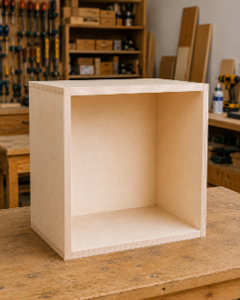
Most stock cabinets are built with particleboard or MDF carcase boxes — materials that are cost-effective but vulnerable to moisture, weight, and time. At B|A, we build our cabinet boxes from maple veneer plywood. It’s dimensionally stable, holds fasteners and hinges far more securely, and handles the humidity swings that are simply a fact of life in an Ontario kitchen or bathroom.
The difference isn’t visible when the doors are closed. But it becomes very visible five or ten years down the road when one kitchen is still performing perfectly and the other is warping, sagging, or pulling away from the wall.
The Drawers: A Detail That Tells You Everything
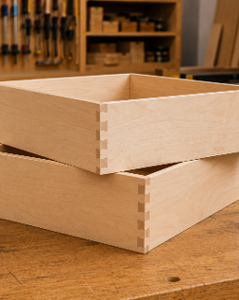
Open a drawer. That’s it — that’s the test.
In a custom cabinet, you’ll find dovetail drawer boxes: solid wood, interlocked joints, built to take years of daily use without loosening or separating. In most stock cabinetry, you’ll find stapled together MDF or a plastic drawer box.
Dovetail joinery is older than most buildings in this country. It’s survived this long because it works. When clients ask us how long their cabinets will last, we point them to the drawers first.
The Edges: The Little Things That Separate Good From Great
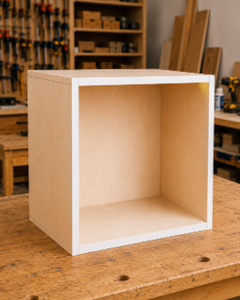
Every exposed plywood edge in a cabinet box needs to be finished. In a properly built cabinet, that means edge tape — a thin strip of matching material applied with heat and trimmed flush. It’s a small detail, but it’s what keeps moisture out, gives the cabinet a clean finished appearance, and tells you something about the care that went into the whole piece.
Skip it, and you have a raw edge that absorbs moisture, chips, and shows its age quickly. It’s one of those things that separates a cabinet built to last from a cabinet built to ship.
The Hardware: What You Touch Every Day
Hardware is one of the most tangible differences between price points. We install soft-close hinges and drawer slides on everything we build — not as an upgrade, but as a standard. The mechanism that slows a door or drawer in the last few inches of travel is a precision component. It protects the cabinet, the door, and frankly the sanity of everyone in the house.
Quality hardware from manufacturers like Salice and Blum is engineered to handle tens of thousands of open-and-close cycles. The hinges and slides on a stock cabinet are engineered to hit a price point.
The Finish: What You See and Live With
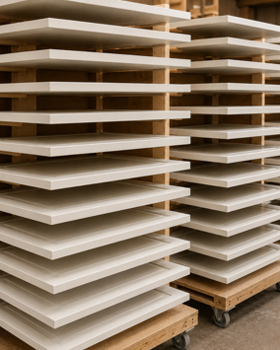
Our in-house finishing department uses premium water-based pigmented lacquers and stains. The finish is applied in controlled conditions, sanded between coats, and cured properly before installation. The result is a surface that holds its colour, resists everyday wear, and can be touched up if needed years down the line.
Paint-grade stock cabinets are typically sprayed at a factory, packed immediately, and shipped. The finish is adequate. Ours is something you’ll notice every time the light catches it right.
What Custom Actually Means
Beyond materials and construction, there’s something else that stock cabinets simply can’t offer: your space, built for your space.
Stock cabinets come in fixed increments. Your kitchen doesn’t. That gap filled with a filler strip, that corner solution that wastes two feet of storage, that island that’s almost the right height — these are the compromises that come with off-the-shelf.
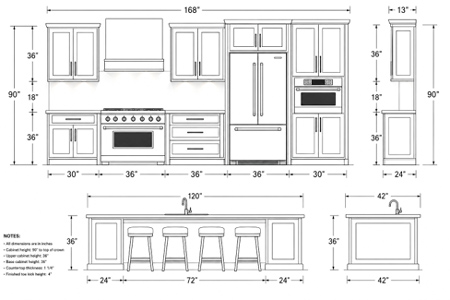
With custom cabinetry, your design is drawn to your exact measurements. Storage is designed around how you actually cook and live. The island height works for your family.
The pantry pull-outs hold exactly what you need them to hold.
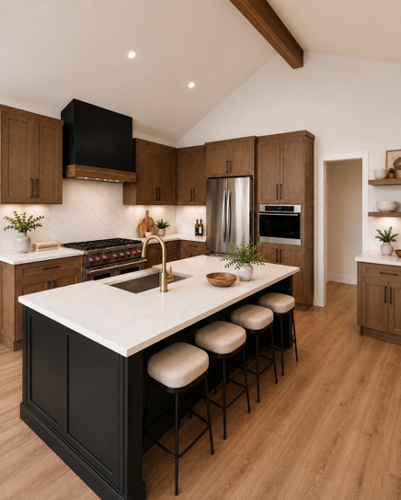
We use 3D design software to show you your finished kitchen before a single board is cut — wall elevations, birds-eye views, the works. You see it, we adjust it, and only then
do we build it.
The Long View
Custom cabinets are a long-term investment in your home. They increase resale value, they outlast the trends, and — perhaps most importantly — they don’t need to be replaced when the next owners move in.
We’ve built kitchens that clients tell us they’ll never want to leave. That’s not an accident. It’s the result of materials chosen for performance, construction methods proven over decades, and details that most people never notice consciously but always feel.
When you’re comparing quotes, you’re not just comparing prices. You’re comparing what’s inside the box.
Ready to See the Difference?
We’d love to show you what’s possible in your home.
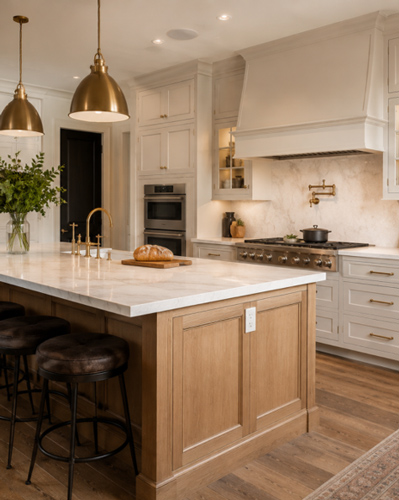
Our process starts with a free in-home consultation — we’ll come to you, take measurements, talk through your vision, and put together a 3D design so you can see it before you commit to anything.
Call us at 226.304.2345 or email info@bacustomcabinets.ca to get started.
We serve London, Lucan, Komoka, Strathroy, Stratford, St. Thomas, and all surrounding areas.
B|A Custom Cabinets & Millwork is a family-owned custom cabinetry shop based in
Lucan, Ontario. We design, build, and install custom cabinetry and millwork for kitchens,
bathrooms, and whole homes across Southwestern Ontario.